Sunday, October 26, 2014

So, how do we actually do redos and retakes? ... (77)

Well, first of all, we need to agree on this:
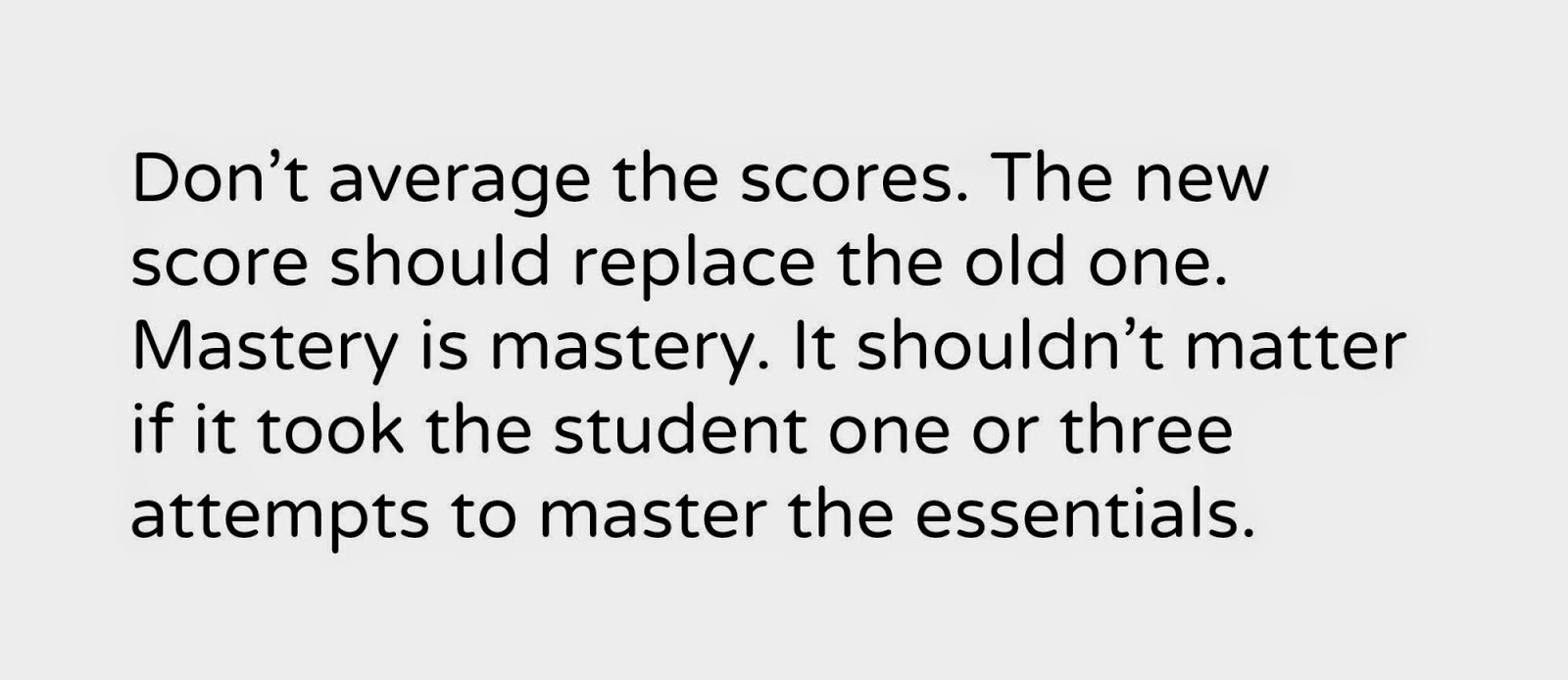

We also need to believe that each student has a right to a grade that accurately and correctly depicts what a kid knows...


We must also agree that a kid doing redos and retakes on the SAME EXACT assignment/assessment WITHOUT participating in some kind of a 'relearn' process is a waste of time.

What about a request to retest document...


You might even like this 'relearn' document: http://goo.gl/P3ce3R


What does my student need to do in order to be reassessed?

After completing an assessment in a standards-based class, the student can ask for a reassessment using the process described below. 

1. The student gets a copy of the reassessment agreement from the teacher and completes the “Standards to Reassess” section to choose what standards the student wants to be reassessed on and at what levels.

2. The student completes the “Preparation Information” by picking a few activities that would help with relearning the material. The student then arranges a meeting with the teacher to discuss the agreement. The teacher may require specific activities to prepare for the reassessment, such as completing missing assignments. Any activities selected by the student or teacher must have evidence that it has been completed.

3. Together, the student and teacher will decide when, where, and how the student will be reassessed in the “Reassessment Information” section.

4. Once all of the relearning activities have been completed, the student will show the necessary evidence to the teacher, and both the teacher and student will sign the “Reassessment Approval” section of the agreement. 

5. The student is now ready to be reassessed as described in the “Reassessment Information” section. The reassessment agreement supports your student’s learning by:
- Ensuring that relearning takes place before reassessment. 
- Identifying the specific steps the student must complete to be reassessed.
- Clarifying the reassessment process for both the student and the teacher.
- Identifying exactly how the student will be reassessed so there are no surprises.


Or even this one: http://goo.gl/nZEVML


You could also take a moment to read what @rickwormeli2 thinks about 'redos and retakes done right.'

@rggillespie has some great thoughts on this topic as well: http://goo.gl/CcfZwH

And, if you need more of Rick Wormeli, check out these two videos:


Sunday, October 12, 2014

Top tweets from the 'Rick' event! ... (75)

Please don't forget to take a few minutes to complete the PD survey from the two days with @rickwormeli2.

https://www.surveymonkey.com/s/ZSKVMFR


Sunday, October 5, 2014

Can we all agree on a few things... (74)

Something that is difficult vs. something that is rigorous...

Asking students to write down and spell all 50 states on a blank map is going to be difficult for most students. Though difficult, this task is not rigorous.

A rigorous assignment would be... collaboratively design and create a presentation focusing on one of the major events in America's history that has affected and/or played a significant role in our current 50 state structure. Be prepared to present this to your classmates and be able to justify/explain why this particular event was so significant in America's history.

Rigor is about complexity and depth. Rigor is about skills that are transferable to other content areas and beyond. Rigor allows for multiple correct answers and rigor is NOT about doing more of something, it's about appropriate level of challenge for each student.

What is differentiated instruction really?

  1. Differentiated instruction is a teaching theory based on the premise that instructional approaches should vary and be adapted in relation to individual and diverse students in classrooms (Tomlinson, 2001).
  2. Think of differentiated instruction as making the learning experience personalized and customized for each student every single day during every single activity.
How important is class time over the course of a school year?

You teach at least 6 classes or 6 hours a day (this accounts for both elementary and secondary teachers). Imagine each 1 hour block takes about 5 minutes to get started and ends about 5 minutes early.  

This means that roughly 10 minutes out of every 60 minutes are underutilized. Over the course of the day, this means that roughly 60 minutes out of every 360 minutes are not spent learning.
Over the course of a typical 5 day week there will be 300 minutes not spent learning out of a total 1,800 potential learning minutes.

Over the course of a typical school year of 174 school days there will be 10,440 minutes not utilized for learning. Let's be realistic and cut that number in half because we all know there are assemblies and other events that cut into learning time throughout the school year. That leaves us with 5,220 minutes of time not spent learning.

5,220 total underutilized minutes divided by a typical 360 minute school day = 14.5 days (or almost 3 weeks) per school year we are letting slip through our fingers. 

The value of an assessment lies only in what is done with the feedback/data as a result of the assessment...

If we aren't doing anything with the feedback/input we are getting from the assessments our students are doing, then we are wasting our time and their time. If we aren't allowing our students to do anything with the feedback/input they are getting from their assessments, then we are missing out on a huge opportunity for student empowerment as part of the learning process.

Frequent, timely, specific & constant feedback is the most important factor in improving student learning and educator effectiveness...

Hattie's research is quite clear on the positive effects of feedback in the educational setting. This goes for not just students, but also educators. It's also worth noting that for feedback to be effective, students and educators both need to see it as formative in nature and not summative. Read more here about the powerful effects of feedback: http://goo.gl/z8NxU9


Sunday, September 28, 2014

A few questions to ask yourself... (73)

1). What percent of your students are going beyond just compliance and are actually cognitively engaged in deep self-driven and relevant learning?

2). How often are students in your class offered the opportunity to move around and get 'the blood' flowing with some type of physical activity?

3). How often are kids in your class able to work in teams and work collaboratively on some type of group learning activity?

4). When was the last time you read a professional book or article and you tried something new as a result of what you read in the book/article?

5). If you had to describe the perfect and ideal classroom, what would be your top three most important characteristics?

6). How confident are you that your students could tell someone who doesn't teach what you teach specifically where they are struggling and where they are succeeding in regard to their learning?

7). Let's assume audio was recorded for an entire week in your classroom. Of all the voices that are heard during that time, whose voice do you believe would be heard the most?

8). If you eliminated all the grades in your classroom, do you think students would still actively participate and continue learning?

9). If a group of teachers from another school district who taught a similar content/grade came and observed your classroom, what do you think they would say in their post-conversation?

10). If you were the principal for the week and you got to observe every classroom in your building, what would you want to see in all the classrooms?

11). What's the ratio of consumption to creation in your classroom when it comes to the work students are doing?